Where do I fit in all this?
A note on form
I don’t usually split my essays into sections. I prefer one continuous piece, where each paragraph has to earn the next. This one breaks that rule, and I’d rather say why before it starts.
What follows began as a bad night after an election and turned into a week of reading about three republics: France, Italy and Brazil. It carries a lot of names, dates and numbers, and a single block of text that size would be tiring to walk through. So it comes in thirteen sections.
They are not chapters. They are stops along one argument, meant to be read in order. And the argument is simple to state: I went looking for my place on the political map, and the map turned out to be missing a dimension.
Sorrowful results
On 4 October 2026, Santa Catarina handed one party nearly everything it could hand out. Governor Jorginho Mello (PL) was re-elected in the first round with 68.98% of the valid votes. Both Senate seats went to the Liberal Party as well: Carol de Toni with 33.46% and Carlos Bolsonaro with 25.35%. Counting the senator already in office until 2031, the PL now holds all three of my state’s seats in Brasília, and 16 of the 40 seats in the state assembly.
I didn’t vote that day; I was away from my electoral district and justified my absence. But I knew exactly where my three non-blank votes would have gone. Mário Motta for the state assembly, Esperidião Amin for the Senate, Raimundo Colombo for the federal Chamber. Three men from Santa Catarina, like me, with long careers, a record of running things, and qualifications of their own for the posts they were seeking.
One of the three made it. Motta was re-elected with 34,977 votes. Colombo ended up as an alternate, with 54,545. Amin came third in the Senate race, with about 15%, and the press summed it up in one line: the end of half a century of public life.
Nationally, the picture was just as tight and just as personal. Flávio Bolsonaro, the former president’s son, finished first with 47.03%, against Lula’s 45.16%; they meet again in the runoff on 25 October. Abstention reached 21.08%, the highest since 1998. From February the PL will have 28 of the Senate’s 81 seats, the largest bench any party has started a legislature with since 1988.
I call these results sorrowful, and that is my judgement, not a fact. The fact underneath it is concentration. In my state, one party now holds every Senate seat, and two of the names that won carry the same surname as the national candidate.
My first reaction, at two in the morning, which I thought was measure at least to some degree, was in fact not measured. I told myself the country was over, that ninety percent of the Senate had become a personality cult. The real figure is 28 of 81. The exaggeration said more about me than about the Senate, and this essay begins with that: with trying to understand why a result in my own state hit me so hard, and where exactly I stand.
The test
The day after the election, almost as a game, I took a party-affinity quiz for the two European countries I feel closest to: France, whose language I speak and whose history I love, and Italy, where I hold citizenship. Sixty-three statements, from wealth taxes to NATO, each answered on a five-point scale and compared with the coded positions of ten parties per country.
In France, my closest match was the Parti Communiste Français, at 73%. La France Insoumise came next with 68%, then the Parti Socialiste with 67%. In fourth place, at 64% and ahead of the Greens, was the Rassemblement National. In Italy, the winner was the Movimento 5 Stelle, at 72%, followed by the Greens-and-Left alliance (AVS) and the Partito Democratico.
A Brazilian does not read “communist” calmly. Here the word is an insult, the oldest one in our political vocabulary. In France it names a party that fought in the Resistance, sat in several governments, and today polls around 2% under a leader who defends nuclear power and secular schools. Same word, different country, different weight.
The quiz, of course, was improvised, and its party positions were approximations. But the pattern behind the numbers was too clear to dismiss. I came out firmly on the left on the economy: tax large fortunes, keep strategic sectors under the state, refuse austerity. I came out sovereigntist on Europe: wary of more integration, against the EU–Mercosur deal, skeptical of NATO. I was firmer than the left on immigration and on secularism, liberal on individual freedoms such as abortion, assisted dying and cannabis, and in favour of nuclear energy.
No single party holds that combination, which explains why the top four were separated by a few points, and why a party of the nationalist right sneaked into the list. A test like this places you on a plane. What it can’t tell you is whether the plane is the right shape. That question is where the rest of this essay goes.
Democrat or Republican?
If you read this essay’s title in English, you probably thought of Washington: donkeys and elephants, blue states and red states. That is the confusion I want to start from, because the question was first asked in French, and it meant something else entirely.
On 30 November 1989, the weekly Le Nouvel Observateur ran a cover essay by Régis Debray titled “Êtes-vous démocrate ou républicain?” Debray was no armchair theorist. In 1967 he had been arrested in Bolivia near Che Guevara’s guerrilla column and spent more than three years in prison there; later he advised François Mitterrand. By 1989 he had become one of the fiercest defenders of the secular French republic.
The timing was not accidental. That October, a middle school in Creil, north of Paris, had excluded three Muslim pupils who refused to remove their headscarves in class. The case split the country. On 2 November, Debray, Élisabeth Badinter, Alain Finkielkraut, Élisabeth de Fontenay and Catherine Kintzler signed an open letter to teachers titled “Profs, ne capitulons pas!” (Teachers, let’s not surrender!). Their argument was that the secular school was these girls’ surest ally against the authority of their fathers. Debray’s essay, four weeks later, widened the quarrel into a theory.
His thesis is that France had been mixing up two ideas that only look alike. The republic, born of the Revolution, rests on the citizen, the school, the law and the nation, and on common ends pursued in a shared secular space. Democracy, in the sense he gives it, is the Anglo-Saxon model: the individual, civil society, communities and the market, each pursuing private ends within a minimal frame. Both are democratic in the ordinary sense. They simply answer different questions about what holds a people together.
Two of his lines have stayed with me. The first: “On peut se dire républicain sans se conduire en démocrate… on peut être démocrate sans être républicain” (One can call oneself a republican without behaving as a democrat… one can be a democrat without being a republican). His examples are the constitutional monarchies of Britain, Spain and Belgium. The second is sharper: “Une république d’illettrés est un cercle carré, parce qu’un ignorant ne peut être libre” (A republic of illiterates is a square circle, because an ignorant person cannot be free).
Debray did not pretend to be neutral. He was a republican, and he feared that France, in 1989, was drifting toward the democratic model. The open letter and the essay have their critics, too: to some on the left, they founded a secularism that ended up aimed mostly at Muslims. That criticism deserves a hearing, and I’ll come back to it, because a republic that applies its principles to one group only has stopped being a republic.
Now look at Washington again. By the measures political scientists use to compare party programs, the Democratic Party sits near the center on economics, closer to Europe’s liberals than to its social democrats. The United States never built a mass socialist party; in 1906 the German sociologist Werner Sombart wrote that socialist utopias “of every sort” were wrecked there “on the reefs of roast beef and apple pie.” And on culture and identity, American Democrats are well to the left of much of the European left. In Debray’s vocabulary, the whole American system, both of its parties included, is democrat.
That is where the pun stops being a joke. When a Brazilian is asked today whether he is a Democrat or a Republican, the question arrives with American meanings attached. In Debray’s sense, I am a republican. In the American sense, I am neither. And in Brazil, as I’ll show later, “republican” has become the name of something I would never vote for.
Why I am a republican
My own answer, before I read anything, was instinctive. The republic seemed to me the obvious next step of civilization: the moment a people stops being ruled by whoever is strongest and starts being ruled by something everyone shares. Monarchy, philosophically, felt like the animal kingdom with a crown on.
That formulation doesn’t survive much scrutiny. Kings ruled by dynasty and by the sacred, not by brute strength; Hobbes defended the absolute sovereign precisely as the way out of the war of all against all. And several monarchies today are perfectly functioning democracies. But underneath the clumsy wording there is an old and much stronger idea, and once I found it, everything else in this essay lined up behind it.
It goes back to Aristotle. In the Politics, he writes that “he who bids the law rule may be deemed to bid God and Reason alone rule, but he who bids man rule adds an element of the beast.” In 1656, James Harrington called a legitimate commonwealth “the empire of laws, and not of men.” John Adams wrote it into the Massachusetts Constitution of 1780: the powers are separated “to the end it may be a government of laws and not of men.”
Rousseau gave it the definition I now use. “J‘appelle donc République tout État régi par des lois, sous quelque forme d’administration que ce puisse être” (I call a Republic any State ruled by laws, whatever its form of administration). By that standard, the question is not whether a country has a king, but who governs: a person, or the law. A constitutional monarchy where the crown is a ceremony is, in practice, what Tennyson called a “crowned republic.” And a republic where one man’s will outweighs the law has kept the name and lost the thing.
This is also what I mean by liberty, equality, fraternity, and by the unity and indivisibility of the Republic. The old revolutionary motto added “or death”. I always read that as a willingness to die for the Republic, not to kill for it, and I keep it in that sense. Rights that are universal must be universal. A republican who defends them for some and not for others is not a republican on principle; he is one by convenience.
The distinction between principle and convenience has a second form, and it matters for everything that follows. Max Weber, in his 1919 lecture Politics as a Vocation, wrote that there are two ways of making politics one’s vocation: one lives either “for” politics or “off” it. I’d put it as the difference between the political man and the man of politics. The first serves something larger than himself. The second uses that larger thing to serve himself.
Which brings me to the personality cult, the thing I find hardest to forgive in Brazil’s present. Not every devotion to a political figure is empty. People revere the American founders, or Getúlio Vargas, because those figures built something real; I can understand that even when I don’t share it. What troubles me is devotion to a figure who stands for nothing in particular, onto whom everyone projects whatever they want.
The Argentine theorist Ernesto Laclau gave this a name: the “empty signifier.” In On Populist Reason (2005), he argued that a people forms when many unmet demands gather around one name that can stand for all of them precisely because it is vague. The irony is that Laclau approved of this; he saw it as how popular movements are born. I see it as the moment the government of laws starts sliding back into the government of a man. That’s the line I’ll be drawing through the rest of this essay, and I’ll have to draw it honestly, because some of my own heroes stand close to it.
The French republican left
If my quiz results had a name in France, it would be the gauche républicaine: a left defined less by class or identity than by the state, the school, secularism and national sovereignty. To understand it, you have to start with the moment it lost the argument inside its own camp.
In 1981, François Mitterrand became the first Socialist president of the Fifth Republic, governing with the Communists. His first two years were the most left-wing program of any major Western country at the time: the death penalty abolished, a 39-hour week and a fifth week of paid holiday, retirement at 60, and the nationalization of five industrial groups and thirty-nine banks.
It lasted until March 1983. Facing capital flight and pressure on the franc, Mitterrand had to choose between leaving the European Monetary System to keep his program, or staying in Europe and turning to austerity. He chose Europe. The French call it the tournant de la rigueur, and it set the course of the French left for the next forty years.
One minister refused to follow. Jean-Pierre Chevènement, the minister of industry, resigned that same month. Shortly before, he had coined the sentence that still defines him: “Un ministre, ça ferme sa gueule ; si ça veut l’ouvrir, ça démissionne” (A minister keeps his mouth shut; if he wants to open it, he resigns). He would do it twice more. In 1991 he left the Defense ministry rather than take France into the Gulf War. In 2000 he left the Interior ministry over a plan to give Corsica its own legislative powers, because in his view the Republic was one and indivisible, or it was nothing.
What Chevènement and his allies feared most was Europe as it was being built. Their objection was not to cooperation between nations but to rules placed out of voters’ reach: an unelected Commission, an independent central bank, a single currency that took away a government’s control over exchange rates and interest, and competition rules that forced open public services like electricity and the railways. For a republican, sovereignty belongs to the people and is exercised through representatives they can remove. A rule that no parliament can change is a loss of sovereignty, however technical it sounds.
The 1992 referendum on the Maastricht Treaty showed how deep that worry ran. The oui won with just 51.04%. On the non side stood Chevènement and the Communists on the left, and Gaullists like Philippe Séguin and Charles Pasqua on the right. Thirteen years later, in 2005, the French rejected the European Constitutional Treaty by 54.67%. In 2008, its substance came back as the Lisbon Treaty and was ratified by Parliament, without another vote. For many French people, that was the proof that a referendum did not count when Brussels disagreed.
Chevènement ran for president in 2002 on exactly this ground, calling on “the republicans of both banks”, left and right, to unite. He got 5.33%. Then came the night the French still call le 21 avril.
| Candidate, first round 2002 | Vote |
| Jacques Chirac (Gaullist right) | 19.88% |
| Jean-Marie Le Pen (far right) | 16.86% |
| Lionel Jospin (Socialist) | 16.18% |
The left had split its vote among eight candidates, and the Socialist prime minister missed the runoff by fewer than 200,000 votes. Many blamed Chevènement. Two weeks later, the whole republican spectrum, left included, voted for Chirac against Le Pen. Chirac won with 82.21%. The left’s unofficial slogan was “Votez escroc, pas facho“: vote for the crook, not the fascist.
I recognize that dilemma. It is the one many Brazilians face now: voting not for a candidate but against another. The French called the reflex the front républicain, and for decades it kept the far right from power.
The republican left still exists, scattered. Arnaud Montebourg preached “démondialisation” and “Made in France” as a minister. Fabien Roussel has made the Communist Party pro-nuclear, secular and focused on work, which is probably why it topped my quiz. In 2019, Emmanuel Maurel and Marie-Noëlle Lienemann founded a small party actually named Gauche Républicaine et Socialiste. None of them gets more than a few percent.
The tradition has a foundation and a stain, and both belong in this essay. The foundation is the law of 9 December 1905, which separated church and state: “La République assure la liberté de conscience… La République ne reconnaît, ne salarie ni ne subventionne aucun culte.” It was written mainly to remove the Catholic Church, my own, from the state. That is why I want secularism for everyone, not for one faith.
The stain is Jules Ferry, the father of free, compulsory and secular schooling. On 28 July 1885, defending colonial expansion before the Chamber, he declared: “il faut dire ouvertement qu’en effet les races supérieures ont un droit vis-à-vis des races inférieures” (it must be said openly that the superior races have a right over the inferior races). The Republic did not protect France from empire; it often justified empire as a civilizing mission.
But the same debate also shows the tradition correcting itself. A deputy, Jules Maigne, shouted back: “vous osez dire cela dans le pays où ont été proclamés les droits de l’homme !” (you dare say that in the country where the rights of man were proclaimed!). Two days later Georges Clemenceau answered from the tribune: “Races supérieures ! Races inférieures ! C’est bientôt dit.” (Superior races! Inferior races! That’s easily said.) Universal rights are either universal, or they are rhetoric. The republicans who remembered that were the real ones.
De Gaulle, or “strength that bows”
For many Brazilians, “de Gaulle” is first of all an airport. Gaullism, then, would be a political movement founded in honor of a terminal at Roissy. The joke is absurd, which is why I like it, and it hides a real question: what do I do with a man I admire who embodied, more than almost anyone in the twentieth century, personal power?
The record is familiar. On 18 June 1940, from London, an almost unknown general called on the French to keep fighting when their government was signing an armistice. In 1958, brought back by the crisis in Algeria, he wrote a constitution around a strong presidency, which the jurist Maurice Duverger would later call a “republican monarchy”. He gave France its own nuclear weapons, tested for the first time in 1960. In 1966 he pulled France out of NATO’s integrated military command. He twice vetoed Britain’s entry into the European Community. He wanted a Europe of states, not a federation above them.
His memoirs open with the sentence every French schoolchild knows: “Toute ma vie, je me suis fait une certaine idée de la France” (All my life I have had a certain idea of France). That idea is the core of what the republican left and the Gaullist right later shared: national independence, a state that plans, a Republic that answers to no outside power.
I believe nations need strong figures, especially in times of war. That puts me in some tension with everything I said in the previous section about the government of laws. De Gaulle’s opponents saw the danger clearly: in 1964, Mitterrand called the Fifth Republic “le coup d’État permanent“. The machine de Gaulle built for himself has served every president since, including some who were far smaller than him.
What resolves the tension for me is April 1969. De Gaulle put a reform of the Senate and the regions to a referendum and staked his office on it. On 27 April, 52.41% voted no. Just after midnight, a two-line statement came from his home in Colombey: “Je cesse d’exercer mes fonctions de Président de la République. Cette décision prend effet aujourd’hui à midi” (I am ceasing to exercise my functions as President of the Republic. This decision takes effect today at noon). He never returned to power.
That is the difference between a strong figure and an idol. The idol bends the law to keep himself in place. The strong figure, when the people say no, bows and leaves. Strength placed at the service of the Republic, not above it, is the only kind I can defend.
The Gaullist inheritance is still visible. France holds an estimated 290 nuclear warheads, the largest arsenal in the European Union, and remains outside NATO’s nuclear planning group: the decision to use them belongs to the president alone. In 2020 and again in 2025, Emmanuel Macron opened a debate on a “European dimension” of that deterrent, meaning a French umbrella for its neighbors. In March 2026 he ordered more warheads and announced France would stop publishing the arsenal’s size. Sovereignty, de Gaulle’s word, is now being stretched to cover a continent, by a president who, as the next section shows, is a strange heir.
Interlude: Macron, or the man on every quadrant
Back in 1989, Debray slipped a small prophecy into his essay: “Le républicain n’aime pas l’économie, qui le lui rend bien. Les inspecteurs des Finances, eux, adorent la démocratie” (The republican doesn’t love economics, which returns the feeling. Finance inspectors, for their part, adore democracy). Twenty-eight years later, a former inspecteur des Finances was elected president of France.
Emmanuel Macron is the most useful foil I know for the question of where one fits. He began as an investment banker, became a minister in a Socialist government, declared in 2016 that “honesty obliges me to tell you I am not a socialist”, and won the presidency in 2017 as neither left nor right. His doctrine has a name, en même temps, “at the same time”, and the internet has had a lot of fun with it.
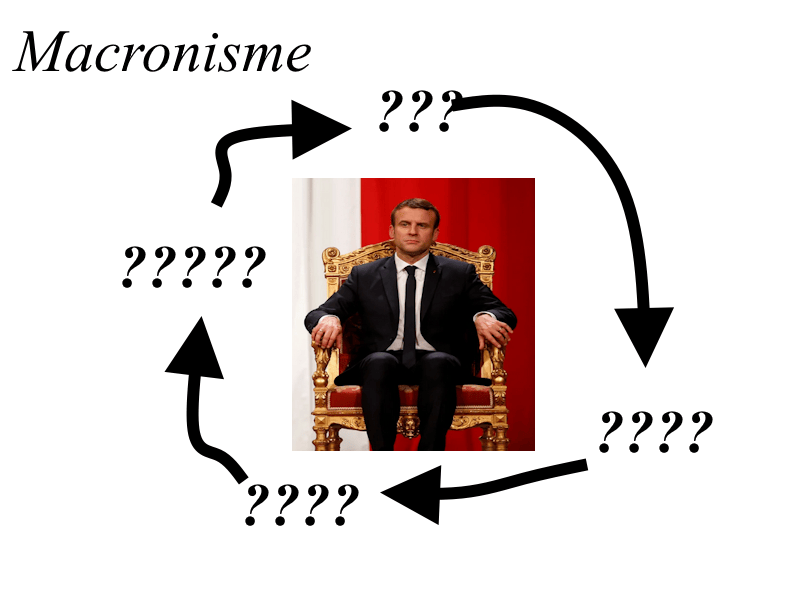
The first image says it in one look: around the man on the gilded chair, Macronism turns in a circle of question marks. The second is more elaborate. Someone took the familiar political compass, with its four quadrants, and filled every square with a Macron quote.
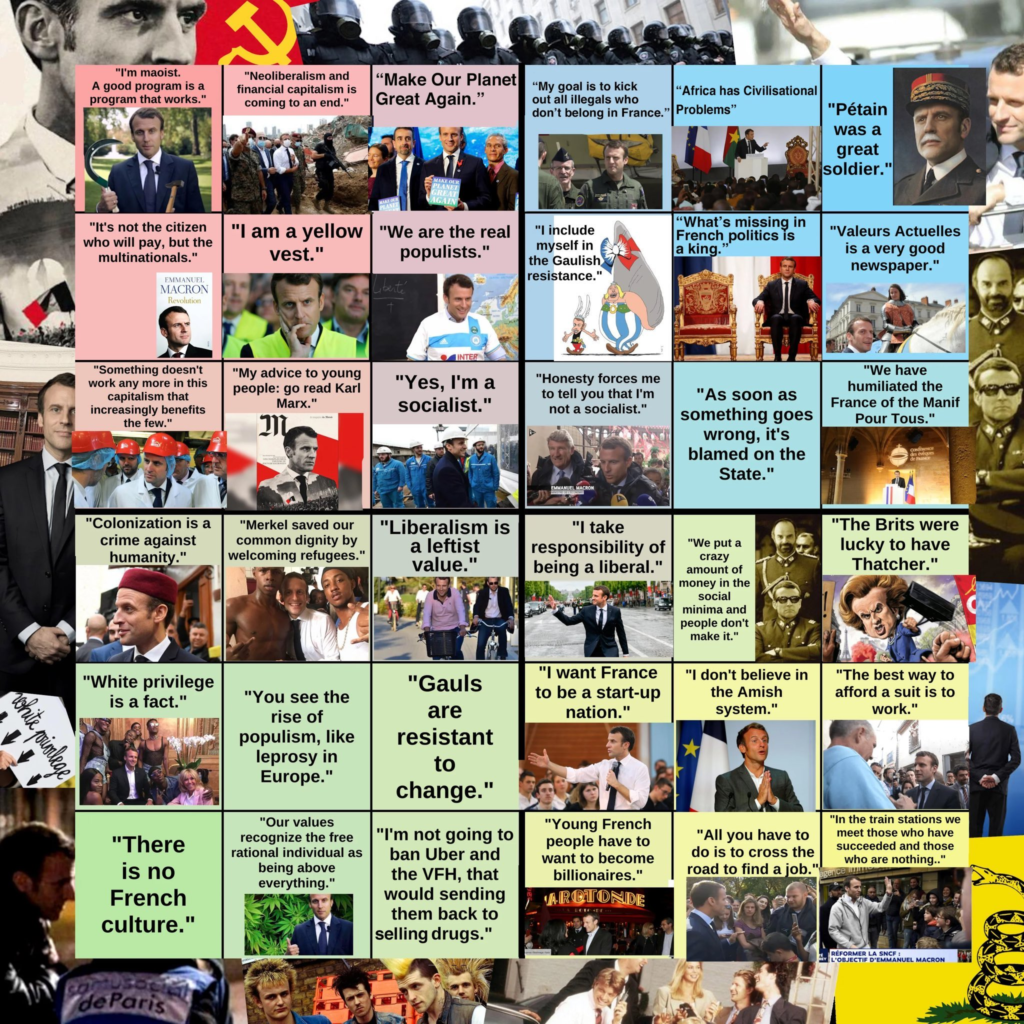
The collage exaggerates, but less than you’d think. In Algiers, in February 2017, he told a television channel that colonization was “un crime contre l’humanité“. In Lyon that same month he said “il n’y a pas une culture française, il y a une culture en France, elle est diverse.” In June 2017 he described a railway station as a place where “one meets people who succeed and people who are nothing.” In 2018 he told an unemployed gardener “je traverse la rue, je vous en trouve” (I cross the street and I’ll find you one), called the French “Gaulois réfractaires au changement” (Gauls resistant to change), and said Marshal Pétain had also been “un grand soldat” in the First World War. On a flat map, those sentences land everywhere.
But there is one direction in which Macron is entirely consistent. In 2015, still a minister, he gave an interview that explains a great deal: “Il y a dans le processus démocratique et dans son fonctionnement un absent. Dans la politique française, cet absent est la figure du roi, dont je pense fondamentalement que le peuple français n’a pas voulu la mort” (There is an absence in the democratic process. In French politics, that absence is the figure of the king, whose death I fundamentally believe the French people did not want). The press shortened it to “il manque un roi“, which he never quite said, but the meaning survived. A year later he promised a “Jupiterian” presidency, distant and above the fray.
He governed that way. His prime minister Élisabeth Borne used Article 49.3, which passes a bill without a vote in the Assembly, twenty-three times, including for the 2023 pension reform that raised the retirement age from 62 to 64. In June 2024, on the evening of a European election, he dissolved the National Assembly almost alone, surprising even his own allies.
In fairness, all of it was legal. The Fifth Republic was designed by de Gaulle to give the president that height, and Macron used what the institution offered rather than defying it. He is no populist tearing institutions down. He is a vertical president in a vertical frame.
And here the image becomes useful for me. On the flat compass, Macron and I look alike: scattered points that fit no quadrant. The difference only shows on the axis the compass leaves out. He rises toward the throne. I’d like to rise toward the law.
The Italian republic: born in the mountains
My family carries a memory I can’t fully document. Someone on one side of it, a relative who stayed in Italy when others left, died fighting the Nazis. I don’t know which branch, or which brigade, and the archives I’ve looked at haven’t answered yet. But to be fair, I didn’t ask this question to my relatives who actually know the answer. Still, it is a distant thread. But it is mine, and it is the reason the Italian part of this story doesn’t feel foreign to me.
The Italian Republic was born in the mountains. After the armistice of 8 September 1943, with the Germans occupying the north and Mussolini restored as their puppet, the parties of the anti-fascist opposition formed the Committee of National Liberation. Tens of thousands of partisans went up into the Alps and the Apennines. The largest formations, organized by the Communist Party, were called the Brigate Garibaldi, a name that will matter in the next section. Alongside them fought the liberal-socialist Giustizia e Libertà, the socialist Matteotti brigades and the Catholic Fiamme Verdi. Bologna alone counts more than two thousand fallen partisans. On 25 April 1945, the insurrection in the northern cities began, and the date is still Italy’s Liberation Day.
What happened next is what I envy the most. See, Italy did not get its republic from a general on horseback. It voted for it. In the referendum of 2 June 1946, the first in which Italian women voted nationally, 54.27% chose the Republic over a monarchy that had lived comfortably with fascism for twenty years. The constitution that followed, in force since 1948, opens with a sentence I would happily sign: “L’Italia è una Repubblica democratica, fondata sul lavoro. La sovranità appartiene al popolo” (Italy is a democratic Republic, founded on labor. Sovereignty belongs to the people).
The Italian left that came out of the Resistance was among the most interesting in the world. Its Communist Party, the PCI, was the largest in the West. Antonio Gramsci, who died after a decade in Mussolini’s prisons, gave it its theory of cultural hegemony. Palmiro Togliatti steered it into parliamentary politics. Enrico Berlinguer took it further: he broke with Moscow’s model, proposed a “historic compromise” with the Christian Democrats after the coup in Chile, and in 1981 warned that “today’s parties are above all machines of power and patronage.” In 1976 the PCI won 34.37% of the vote, close to a third of the country, within the rules of a democracy it had helped to found.
Then it ended. The Berlin Wall fell in November 1989; that same month the PCI’s leader announced the party would change its name, and in 1991 it dissolved into what became today’s Democratic Party. The Socialist Party, led by Bettino Craxi, did not get the chance to reinvent itself: from 1992, the Mani Pulite corruption investigations destroyed it, and the Christian Democrats with it. Into the vacuum stepped a television magnate. Silvio Berlusconi won his first election in March 1994, and Italian politics has been organized around personalities ever since.
The postwar Republic left a ledger of rights, and it is worth reading in full.
| Won | Lost or weakened | Never achieved |
|---|---|---|
| Divorce (1970), confirmed by referendum in 1974 with 59.26% | Wage indexation (the scala mobile), cut in 1984; a referendum to restore it lost in 1985 | A statutory minimum wage |
| The Workers’ Statute (1970), including Article 18’s right to reinstatement | Article 18, hollowed out in 2012 and by the Jobs Act in 2015 | Same-sex marriage (only civil unions, since 2016) |
| Legal abortion (1978), confirmed by referendum in 1981 | Citizenship by birth or schooling for children of immigrants | |
| A national health service (1978) | A law on end of life (only a 2019 court ruling) | |
| The Basaglia law closing psychiatric asylums (1978) |
The 1970s, when Italy won most of these, were also its “years of lead”, a decade of terrorism from both the far left and the far right. Its worst moment came in the spring of 1978, when the Red Brigades kidnapped and murdered the former prime minister Aldo Moro. Rights and violence grew up side by side.
Today the generation that marched in 1968 and 1977 has been replaced by one that mostly leaves. Young Italians emigrate in large numbers, and those who stay vote less. In June 2025, referendums to restore protections against dismissal and to shorten the path to citizenship failed because turnout reached only 30.6%, short of the 50% quorum. The current landscape is led by Giorgia Meloni’s Brothers of Italy, around 27% in recent polls, with the Democratic Party near 22%, the Five Star Movement near 13%, and a new party founded in February by General Roberto Vannacci already polling around 8%.
That is the party system in which my quiz put me closest to the Five Star Movement, a party born as a protest against all parties. I take the result as a symptom rather than a home. The Italian tradition I recognize myself in is older: Giuseppe Mazzini’s “Dio e Popolo“, God and the People, and the republic voted into being in 1946 by people who had just come down from the mountains.
Garibaldi, hero of two worlds
If I have a political idol, it is Giuseppe Garibaldi. And the best thing about him, for a catarinense with an Italian passport, is that my two countries meet in his life, in my own state.
In 1839, an exiled Italian sailor fighting for the Farroupilha rebels of Rio Grande do Sul helped capture the port of Laguna, in southern Santa Catarina. On 29 July, the rebels proclaimed the Juliana Republic there. It lasted about four months before imperial troops took the town back in November. A republic, proclaimed in Santa Catarina, half a century before Brazil had one. In Laguna, Garibaldi also met Ana Maria de Jesus Ribeiro, born in 1821 in the south of the state; Laguna and Tubarão still argue over which of them is her birthplace. History knows her as Anita Garibaldi.
From Brazil they went to Uruguay, where Garibaldi led an Italian Legion in the defense of Montevideo. The story goes that his men wore red shirts because the cheapest cloth in the city was meant for slaughterhouse workers; it may be legend, but the red shirt became his uniform for life. In 1848 he went home to fight for Italy. Anita died the following year, pregnant and exhausted, during the retreat after the fall of the Roman Republic.
In May 1860, Garibaldi sailed from near Genoa with about a thousand volunteers, landed in Sicily and, within months, took the whole Kingdom of the Two Sicilies. Then he did the thing that defines him for me: on 26 October 1860, at Teano, he met King Victor Emmanuel II and handed him the south of Italy. He asked for nothing. He went back to his farm on the island of Caprera with little more than a bag of seed.
That is why I call him the opposite of a mercenary. Machiavelli, in chapter 12 of The Prince, says mercenaries are “disunite, ambiziose, sanza disciplina, infedele“: divided, ambitious, undisciplined, disloyal. They fight for pay, so they can never be trusted with a state. Garibaldi was the citizen-volunteer Machiavelli was asking for: he fought for something, and when it was won, he gave it away.
He also gave the Italian language one of its shortest and most famous words. In July 1866, during the war against Austria, he defeated the Austrians at Bezzecca and was advancing toward Trento when the government signed an armistice and ordered him back. His reply, by telegram on 9 August, was one word: “Obbedisco.” I obey. Strength that bows, again.
There is a tension here that I can’t avoid. Garibaldi was a republican, a follower of Mazzini, and he handed Italy to a king. My reading is that he was, above all, for unity, and that he put the nation’s unity ahead of its form of government. There was simply too much weight on the same side of the scale. For a man who believed in the Republic one and indivisible, an indivisible Italy under a crown was better than a republic that didn’t exist.
Eighty years later, the Communist partisans who freed northern Italy from the Nazis named their brigades after him. Somewhere in that story, perhaps, is my relative. And in Laguna today there is a museum in Anita’s house, another in the old town hall where the Juliana Republic was proclaimed, and a whole town in Santa Catarina named Anita Garibaldi. The hero of two worlds left marks in both of mine.
The Brazilian republic that was
Italy voted for its republic. Brazil got its own from a marshal on horseback. On 15 November 1889, Deodoro da Fonseca led the troops that deposed the emperor, and the republican journalist Aristides Lobo wrote that the people watched it all “bestializado“, “dumbfounded”, without understanding what was happening. The Brazilian Republic began as something done to the people, not by them.
It did not begin without ideas, though. The officers who made it had been taught by Benjamin Constant Botelho de Magalhães, a disciple of the French philosopher Auguste Comte. The motto on our flag, “Ordem e Progresso“, is Comte’s: love as principle, order as basis, progress as aim. Brazilian positivism deserves an essay of its own. Here it is enough to say that my country’s republic has French DNA written on its flag.
It also began with a convenient lie about who freed the slaves. Abolition came on 13 May 1888, under the monarchy, and it was the work of many hands: abolitionists like Joaquim Nabuco and André Rebouças, both of them monarchists; the enslaved themselves, who fled the plantations in growing numbers; and the Army, whose officers petitioned in 1887 not to be used to hunt runaways. Meanwhile, many slave-owning planters, furious at losing their “property” without compensation, discovered overnight that they were republicans. Brazilians mocked them as the “republicans of the 14th of May”. The distinction I made earlier, between republicans on principle and republicans by convenience, was born here.
Deodoro’s successor, Floriano Peixoto, earned the name “Marshal of Iron” by crushing the revolts that followed. In 1893 the Federalist Revolution and a naval rebellion made my city, then called Desterro, the rebels’ capital. When government forces retook it in 1894, Colonel Antônio Moreira César oversaw summary executions at the fortress of Anhatomirim, in the bay. The toll is uncertain: the often repeated figure of 185 rests on thin documentation, and I’m wary of it. But historians agree that executions took place. On 1 October 1894, a state law signed under governor Hercílio Luz renamed Desterro after the marshal. I was born in a city named for a man I admire, who did something there I cannot officially defend.
The tradition I recognize myself in came from the south. In Rio Grande do Sul, the positivist Republican Party of Júlio de Castilhos and Borges de Medeiros ran a strong, modernizing state for decades, and Getúlio Vargas came out of it. After 1930, Vargas built much of the Brazilian state: the national steel company, the labor code in 1943, Petrobras in 1953 under the slogan “o petróleo é nosso“. He also ruled as a dictator from 1937 to 1945, and his propaganda department sold him as the “father of the poor”. I said I understand devotion to figures who built something. Vargas is where I have to admit that building something and being worshipped are not mutually exclusive, and that the cult was real. Pressured by conspirators all around, he managed to stop a coup and left office the only way left to him: by suicide, in 1954, with a letter that ends “Saio da vida para entrar na História” (I leave life to enter History).
His heirs founded the Brazilian Labor Party, the PTB, which the military dictatorship abolished in 1965 along with every other party. When democracy returned, Leonel Brizola and the anthropologist Darcy Ribeiro tried to revive the tradition in a new party, the PDT. In the first round of 1989, Lula got 17.18% and Brizola 16.51%. The trabalhismo of Vargas missed the runoff by less than one point and never got that close again.
Four years later, in 1993, Brazil finally held the vote it had skipped in 1889. Asked to choose between republic and monarchy, 86.6% of valid votes chose the republic. Asked to choose between presidentialism and parliamentarism, 69.2% chose a strong president. We voted for the republic, and in the same breath for a personal form of power, much like France’s Fifth Republic.
The man I would have voted for in 1994 and 1998 was Fernando Henrique Cardoso, a sociologist who had co-written one of the classic books of dependency theory and then, as finance minister, ended hyperinflation with the Plano Real. He won both elections in the first round. He is also the subject of a famous sentence he never said: “esqueçam o que escrevi“, forget what I wrote. He has denied it for decades.
He is in good company. The most famous sentence about my country, “Le Brésil n’est pas un pays sérieux” (Brazil is not a serious country), is attributed to de Gaulle. He never said it either. It came from a Brazilian, the ambassador Carlos Alves de Souza, describing his own words to a journalist during the “Lobster War”, a fishing dispute between Brazil and France in the early 1960s. Politics lives on quotable myths. The ones about Brazil happen to be quoted by Brazilians.
Imported frames
My suspicion, after all this reading, is that Brazil’s political conversation increasingly runs on borrowed grammar. We import the frames of American politics, its two poles, its culture war, its drug war, its style of devotion to a leader, and we apply them to a country they were never built for. Sometimes we adopt them just as the United States is starting to abandon them.
The clearest case is drugs. In 1971 Richard Nixon called drug abuse “public enemy number one”, and the United States spent the next forty years building prisons around that phrase. Since 2012, more than twenty American states have legalized recreational cannabis, and in 2022 the president pardoned federal convictions for simple possession. Brazil went the other way. Our 2006 drug law removed prison for users but left the line between user and dealer to the police officer’s judgement on the street. Incarceration grew steeply, and drug charges became one of the main reasons people are imprisoned in Brazil, especially women. Only in 2024 did the Supreme Court set a threshold, 40 grams of cannabis, below which possession is presumed to be for personal use. The Senate responded with a constitutional amendment to criminalize possession of any amount.
The second case is the shape of the conversation itself. Brazil does not have two parties. From 2027, thirteen parties will hold seats in the Senate alone. Yet public debate increasingly sounds like a binary of two tribes, each defined by hatred of the other. The most absurd symptom is in the vocabulary. “Democrat” and “Republican” have no Brazilian meaning, yet they float around our debates as if they did. And the word republican, the word of Debray, Clemenceau and Garibaldi, is now in Brazil the name of a party, Republicanos, closely tied to the Universal Church of the Kingdom of God, whose president is one of its bishops.
That leads to the third case: religion in politics. According to the 2022 census, evangelicals grew from 21.6% of Brazilians in 2010 to 26.9%, about 47 million people. The evangelical caucus in Congress counts more than two hundred deputies. Sure, most of these believers are ordinary people at the church on their corner, many of them poor, many of them women, and they vote in every direction. My concern is not with them. It is with the radicalization of some neo-Pentecostal movements, and with “dominion theology”, the idea that believers should take over every sphere of power. That idea came largely from the United States. It is exactly what secularism, applied to every faith including my own, exists to stop.
The fourth case is the personality cult, the one I have the hardest time forgiving. The style of politics in which a candidate’s surname is the whole platform, and loyalty to the leader replaces any program, looks very much like what America has lived through in the past decade.
I have to be fair to the other side of this argument. Brazilian Pentecostalism is largely home-grown: the Assembly of God was founded in Belém in 1911. Our polarization has domestic roots, in the long quarrel between Lula’s supporters and his opponents. Our punitive turn has domestic causes, in real violence, in militias and in organized crime. And, as the last section showed, Brazil invented its own personality cults long before Washington had anything to teach us. Imported frames do not create our conflicts. What they do is give them a script, and it is a script written for another country.
Whoever wins on 25 October, none of this will change. The frames will still be borrowed, the parties will still be many, and the question of where someone like me fits will still be open. That is why this essay doesn’t end with a vote.
Where do I fit?
I started this essay thinking I might be off the map entirely. I don’t think that anymore. I have coordinates on the plane: left on the economy, mixed on values. What the plane can’t show is the thing I care about most, and it turns out political scientists have been measuring it for years.
The familiar compass has two axes: how much the state should do in the economy, and how traditional or libertarian a society should be. But several research programs add a third. Cas Mudde and Cristóbal Rovira Kaltwasser describe populism as a “thin” ideology that pits a pure people against a corrupt elite, and that can attach itself to the left or the right. The Chapel Hill Expert Survey, which places Europe’s parties, now measures how strongly they campaign against elites. The V-Dem project codes how personalized each party is: how far it exists to serve one leader. Thomas Poguntke and Paul Webb call the broader trend the “presidentialization” of politics, the drift of power toward leaders even in parliamentary systems.
That is my axis. At one end, the government of laws: institutions, procedures, offices larger than the people who hold them. At the other, the government of a person: the leader who embodies the nation and speaks to it directly, over the heads of everyone in between. On the flat compass, Macron and I looked equally scattered. On this axis we point in opposite directions.
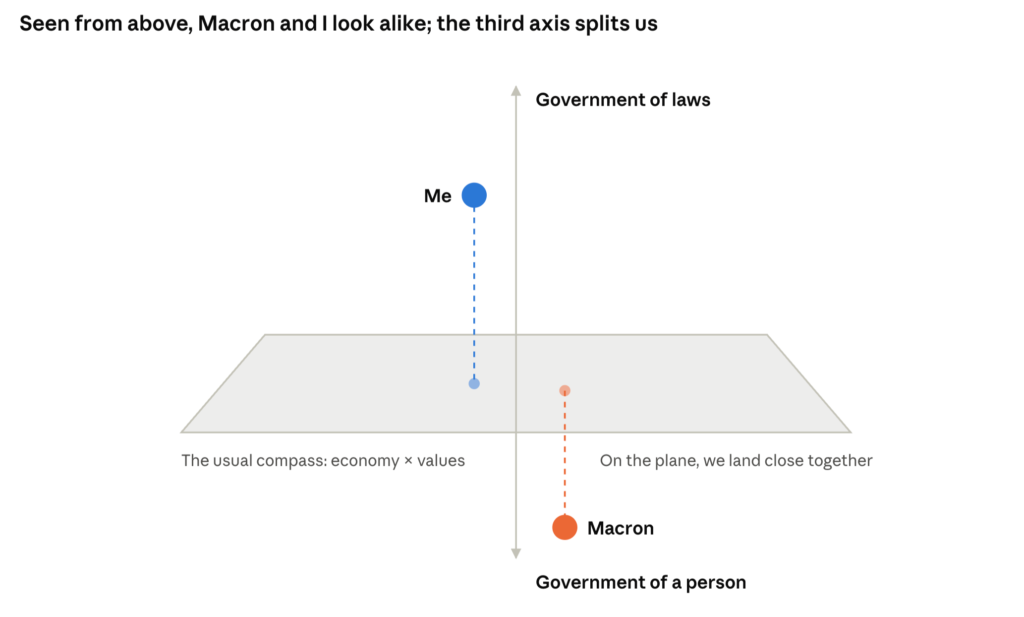
Projected onto the compass, the two points almost meet; along the axis it leaves out, they move in opposite directions.
I have to be honest about where my own heroes sit on it. De Gaulle built a constitution around himself, then left when the people said no. Vargas built a state and a cult at the same time. Floriano gave my city its name and its darkest memory (allegedly). Garibaldi conquered half a country and gave it away. What I admire in all of them is not the strength itself but the moment the strength bowed, or should have. I am not against strong figures. I am against figures who are strong and accountable to nothing.
There is one more tradition I want to name, because it is part of how I was raised even if I don’t practice it. Catholic social teaching, from Leo XIII’s Rerum Novarum in 1891 to Pius XI’s Quadragesimo Anno in 1931, rejected both unregulated capitalism and state socialism. It defended a just wage and workers’ unions, and the principle of subsidiarity: what a smaller community can do should not be taken over by a larger one. G. K. Chesterton and Hilaire Belloc drew from it a program they called distributism, property spread among as many hands as possible. As a citizen, I want the Church kept out of the law. As a person, I find in that tradition a moral argument my politics often lacks.
It came back to me this year, in a video I watched more than once. On 10 June 2026, in a church in Barcelona’s poorest neighborhood, a six-year-old boy named Renzo read Pope Leo XIV a list of questions. Why were his parents so worried? Why did his father have so many jobs? Why did so many people live on the street with no one seeing them? And then: “¿Dios quiere que haya pobres y ricos?” Does God want there to be poor people and rich people? The Pope, smiling with something that looked like sadness and pride at once, shook his head. No.
I don’t know of a better summary of what fraternity means.
On 25 October, Brazil will choose between Flávio Bolsonaro and Lula. I have never voted for Lula, and I will justify my absence again. I’ll admit one thing, though: as a statesman abroad, the man has a gift. In 2003, at the G8 summit in Evian, at a table with George W. Bush and the leaders of the richest countries, he said: “Não queremos o olhar piedoso dos países ricos” (We do not want the pitying gaze of the rich countries). For someone who cares about sovereignty, it is hard not to be moved by that. But whoever wins, the questions in this essay stay where they are.
So, am I a Democrat or a Republican? In the American sense, neither. In the ordinary sense, I am a democrat: I believe in votes, and in losing them. In Debray’s sense, and in the sense of Rousseau, of Garibaldi’s “Obbedisco” and of de Gaulle’s midnight statement, I am a republican. Maybe a tropical Jacobin, as I joke with myself. I don’t live off the plane. I live on it, pulled upward by something the plane can’t draw: the hope that one day my birth country will be governed by its laws, and not by a name.
Sources
- TSE: Flávio Bolsonaro and Lula go to the runoff
- TRE-SC: first-round totals in Santa Catarina
- Agência Senado: Santa Catarina elects Carol de Toni and Carlos Bolsonaro
- TV Senado: party composition of the Senate from 2027
- Revista Oeste: Senate result and Esperidião Amin
- CNN Brasil: the 40 state deputies elected in Santa Catarina
- Hub Político: Raimundo Colombo
- O Povo: final first-round figures and abstention
- Comité Laïcité République: Régis Debray, “Êtes-vous démocrate ou républicain?”
- SNALC: “Profs, ne capitulons pas!”
- Contretemps: a critical reading of republican secularism
- Assemblée nationale: Jules Ferry, 28 July 1885
- Phrasitude: the origin of Chevènement’s quote
- Lys Ardent: Macron’s 2015 interview in Le 1
- Slate: Macron on Pétain, November 2018
- Storia e Memoria di Bologna: memorial to the fallen partisans
- ANSA: Youtrend poll, September 2026
- El Debate: Renzo’s questions to Leo XIV
- FUNAG: selected speeches of President Lula (Evian, 2003)
- University of Toronto G8 Research Group: Evian 2003 delegations
Leave a Reply