Four weeks of looking for a desk is enough to break your faith in the material world. You look at enough digital catalogs and see yourself as a witness to a crime, conducting a slow, unintentional autopsy on contemporary manufacturing. My requirements aren’t exotic: 1.6 meters wide to fit my space, solid wood construction, rounded corners, chamfered legs positioned to create the floating aesthetic where the surface seems suspended in air rather than squatting heavily on the ground, and a finish that doesn’t try to hide the wood grain behind excessive layers of polyurethane attempting to impersonate plastic. I want the wood to be wood, to show its rings and variation, to acknowledge what it is. These are baseline expectations for an object I’ll interact with every single day for potentially decades; an object that will hold my work, my books, my coffee cups, my elbows during long nights of writing or reading or simply staring at the wall thinking. And yet finding something that meets these criteria without costing as much as a used car has proven essentially impossible, which led me to a question that’s haunted me through every furniture website and every vintage store visit: did ordinary people ever actually have access to well-made things, or is this nostalgia for a middle class that never quite existed the way we imagine it did?
The answer is complicated and depends entirely on what you mean by “well-made”, “ordinary people” and which decade you’re romanticizing. If we’re talking about the 1950s and 60s in certain Western countries — the post-war boom years when factory jobs paid middle-class wages and Sears catalogs offered solid wood furniture at prices a machinist could afford, then yes, there was a brief window where mass manufacturing achieved something remarkable: producing genuinely decent objects at scale without completely sacrificing quality to price. But even then, this was geographically and economically limited, available primarily in industrialized nations with strong labor movements and broader wealth distribution than we see today, and it relied on resource extraction and manufacturing processes we now understand were environmentally catastrophic in ways people simply didn’t measure or care about at the time. The wood coming out of those factories wasn’t sustainable-yield forestry; it was old-growth timber from forests that had spent centuries developing density and tight ring patterns, trees that grew slowly in competitive ecosystems and therefore produced lumber with structural integrity we literally cannot replicate today no matter how much money we spend, because you cannot speed up tree growth beyond certain biological limits without compromising the very qualities that make the wood valuable. Old-growth lumber with rings packed closely together, indicating slow growth and high density, is fundamentally different from plantation timber harvested after twenty or thirty years. This is just materials science. The younger wood is more prone to warping, less resistant to impacts, more likely to develop cracks as it ages, and generally lacks the longevity of timber that spent a century or more developing its cellular structure. We’ve harvested the old forests, and they’re not coming back in our lifetimes or our grandchildren’s lifetimes. This is the first critical thing to understand: some aspects of “they don’t make them like they used to” are literally true not because of corporate malfeasance but because the materials themselves don’t exist anymore in sufficient quantities to supply contemporary demand at any price point below luxury.
But, and this is where it gets infuriating, many other materials and manufacturing techniques have actually improved. Modern metal alloys are often superior to their mid-century counterparts, contemporary adhesives create bonds stronger than traditional joinery in certain applications, CNC machining can achieve precision impossible for human hands, and advanced finishing techniques can protect wood better than anything available fifty years ago. The technology exists to make furniture that’s both more durable and more affordable than the “golden age” pieces we fetishize. So why doesn’t it exist in any meaningful market segment between IKEA particleboard and four-thousand-dollar artisan commissions? Why has the middle collapsed so completely that I can’t find a straightforward wooden desk without either accepting something that will disintegrate in two years or taking out what feels like a small mortgage? The answer has less to do with manufacturing capability and everything to do with the economic structures that govern what gets made and for whom.
There used to be a robust furniture middle market, companies whose entire business model was “solid construction at reasonable prices for people who aren’t wealthy but also aren’t indigent,” brands that built reputations over decades by reliably producing the kind of desk I’m looking for: nothing fancy, nothing innovative, just competent woodworking sold at prices that reflected fair labor and material costs plus a modest profit margin. These companies have been systematically destroyed over the past thirty years, not by consumer preference or technological disruption but by private equity firms and corporate consolidation. A family furniture business might have operated for three generations with the understanding that you don’t cut corners because your name is on the product and you’ll see your customers at church or the grocery store, but once that business gets acquired by a holding company optimized for quarterly earnings reports, everything changes. The new owners aren’t furniture people, they’re finance people, and they look at the operation and see inefficiencies everywhere: Why are we using solid wood when particleboard costs a third as much? Why are we employing skilled workers when we can offshore to factories that pay a few dollars per day? Why are we maintaining inventory when we can switch to just-in-time manufacturing that reduces overhead? Each of these decisions makes perfect sense on a spreadsheet, and together they transform a company making decent furniture into a company making disposable garbage while still charging mid-market prices because the brand name hasn’t caught up to the product degradation yet. By the time customers realize they’ve been sold trash, the holding company has extracted maximum value and moved on, possibly selling the gutted brand to another firm that will repeat the process until there’s nothing left but a logo on particleboard made in a factory where nobody has ever seen the original products that built the reputation they’re now exploiting.
This is a documented business strategy with a name, not a conspiracy: “brand harvesting.” You acquire a company with strong customer loyalty, reduce production costs to the absolute minimum while maintaining or even increasing prices, and milk the reputation until it’s worthless, at which point you either shut down or sell to someone who will try to extract the last remaining value. And it’s happened across the entire furniture industry, which is why when I search for desks I find either flat-pack disposability or custom craftwork, with essentially nothing in between. The middle didn’t disappear because consumers stopped wanting it — it was structurally destroyed because it wasn’t profitable enough for the kinds of returns that contemporary financial markets demand, and here’s where we need to talk about what those markets have done to manufacturing more broadly, because furniture is just one visible example of a pattern that’s eaten nearly every product category.
When companies were owned by people who made things, the logic was relatively straightforward: make a good product, sell it for more than it costs to produce, reinvest some profits into the business, pay yourself and your workers, repeat. This model supports middle-market quality because there’s no pressure to maximize returns beyond sustainability and comfortable prosperity. But when companies are owned by shareholders who have no connection to the products and expect returns that beat market indices, the entire calculus changes. You can’t just make a decent desk and sell it at a fair price anymore because “fair” doesn’t generate the growth rates that justify investment. You need to either dominate the bottom of the market through ruthless cost-cutting and volume, or serve the luxury top where margins are high enough to satisfy return expectations. The middle ground, where quality and price are balanced for ordinary prosperity, doesn’t offer the exponential growth that financialized capitalism requires, so it gets abandoned not because it doesn’t work but because it doesn’t work enough for the people who control capital allocation. And those people, crucially, don’t need to buy the products. They don’t care if a desk falls apart in three years because they’re not the ones buying desks from the companies they own, they’re diversified across portfolios where furniture manufacturers are just stock codes, abstract assets to be optimized with no more emotional investment than they’d have in soybean futures.
The result is a market bifurcated so severely that it barely functions for anyone seeking quality without wealth. At the bottom, you have IKEA and its countless imitators producing furniture from MDF and MDP — medium-density fiberboard and medium-density particleboard, materials that are essentially wood waste held together with adhesives and pressed into shapes under heat and pressure. These materials have their place; they’re consistent, they don’t warp like solid wood can, they’re easy to machine, and they’re cheap. But they’re also fundamentally weak, prone to damage from water or impact, impossible to repair in any meaningful way, and designed with lifespans measured in years rather than decades. The edge banding peels off, the screw holes strip because there’s no real wood structure to grip, the surfaces chip to reveal the compressed fiber underneath, and when any of this happens your only option is replacement because you can’t refinish particleboard, you can’t sand it down to fresh wood because there is no wood, just particles. And yet this is what’s available to most people most of the time, sold not just as adequate but as smart and modern and democratic and cheap, as if choosing disposability is somehow more enlightened than wanting objects that last. IKEA’s marketing is particularly crafty in this regard, positioning their products as design-forward and accessible when what they’re actually selling is planned obsolescence wrapped in Scandinavian minimalism, and I say this as someone who has owned IKEA-inspired furniture and understood exactly what I was getting: temporary solutions that would serve until I could afford something real, except increasingly there is no “something real” to graduate into without jumping directly to the artisan tier where a simple desk costs what a month’s rent used to cost.
At that top tier, you find the survivors: individual craftspeople and small workshops making furniture the old way, with traditional joinery and solid wood and attention to detail, and their work is genuinely beautiful and genuinely expensive because they’re paying fair wages to skilled workers, sourcing quality materials, and taking the time required to do things properly. A desk from someone like this might cost three thousand dollars, and that’s not exploitation, it’s what the object actually costs to make when you account for expertise, materials and time without exploiting anyone in the supply chain. But three thousand dollars is inaccessible to most people for a single piece of furniture, which traps everyone in a miserable equilibrium: those who can’t afford quality buy disposable furniture repeatedly, ultimately spending more over time than one quality piece would have cost them while also generating enormous waste, and those who can afford quality feel vaguely guilty about it while watching the middle market they grew up with evaporate entirely. There’s a furniture store in São Paulo called CGS that makes a desk called the Escrivaninha Tânia, and it’s exactly what I’m looking for, clean lines, solid wood, rounded edges, that floating aesthetic where the legs are set back from the front edge so the surface appears to hover and it looks simple, almost plain in photos, but it’s really quite specific, because simplicity is deceptive since those curves and rounds and tapers require actual skill to execute, they require working with wood in ways that reveal rather than hide its nature, and they absolutely cannot be replicated in MDF or MDP because those materials can’t hold the kind of edges and joins that give the piece its character. You can’t round an MDF corner the same way without exposing the fiber composite underneath; you can’t taper legs convincingly; you can’t achieve the subtlety that makes a simple desk visually interesting rather than just plain. And the Escrivaninha Tânia costs accordingly, not because someone is getting rich but because making it properly requires time and skill that have monetary value in a functional economy.
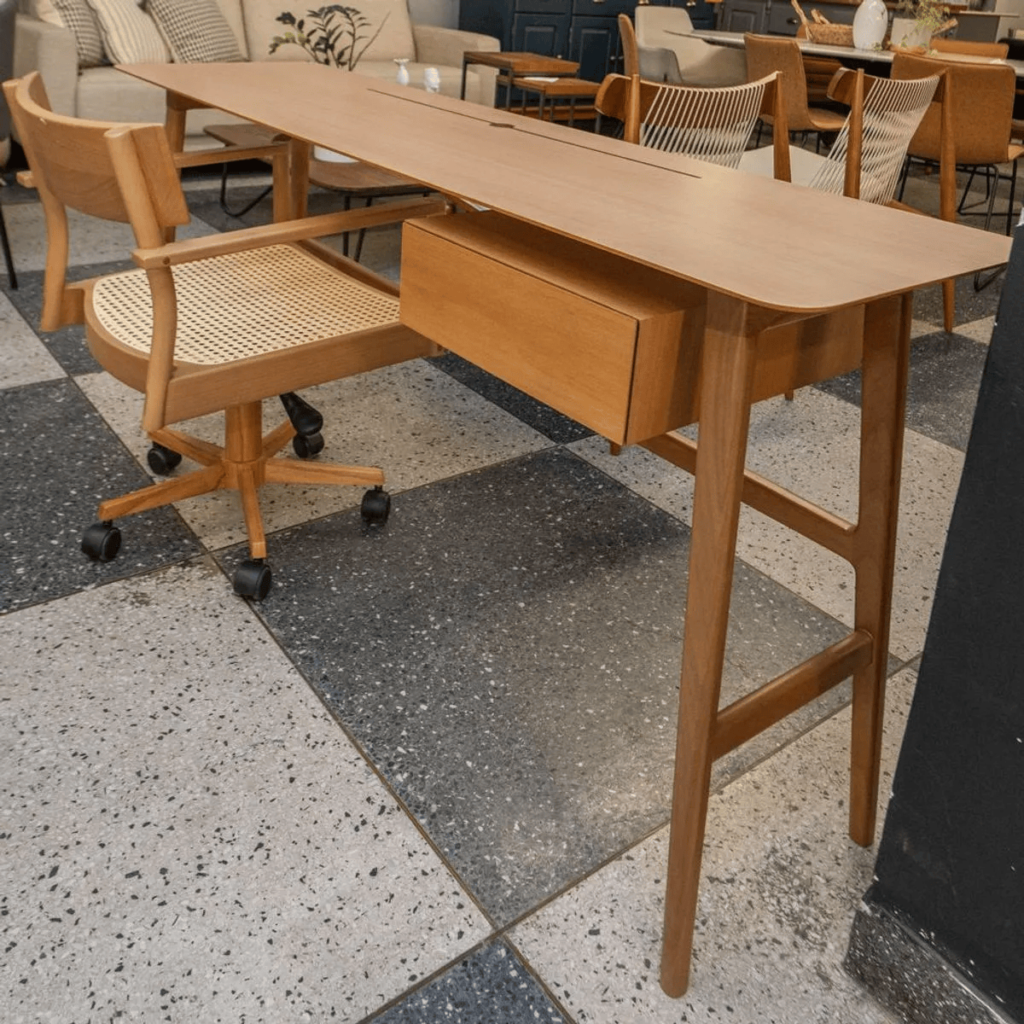
So I’m trapped between a particleboard temporary solution and an investment that feels outsized for an object whose primary function is holding things at a convenient height, except that framing reveals a fundamental misunderstanding of what furniture is and does, because functionality divorced from aesthetics is meaningless to me and I suspect to anyone who thinks carefully about the objects they live with. A desk is not just a platform at seated elbow height; if that were true, a piece of plywood on cinder blocks would suffice and we’d never think about it again. The desk is a presence in your space, an object you see every day, that your eyes travel across constantly, that sets a tone for the room and for your relationship with work and thought. Design value holds it all together as functionality emerges from good design, not the other way around. A well-designed desk is the right height and depth and width, yes, but it’s also visually balanced in a way that makes the room feel intentional rather than randomly assembled, it has proportions that satisfy something pre-rational in your perception, it uses materials honestly in ways that acknowledge what they are rather than pretending to be something else, and so forth. This “frivolity” is acknowledging that we’re visual creatures living in three-dimensional space and pretending aesthetics don’t matter is just inverted snobbery, the insistence that caring about how things look is somehow shallow when in fact it’s one of the most human impulses we have. And this is where living in a relatively small space (ninety square meters isn’t tiny, but it’s not sprawling either) makes quality even more critical, because when space is limited every object becomes more significant, more visible, more present in your daily life. Ultimately, you can’t hide mistakes in other rooms or relegate the ugly practical things to basements and attics you rarely visit. Everything is here, in view, all the time, which means everything either contributes to making this place feel like yours or it contributes to making it feel like a generic staging of “apartment” without personality or particular inhabitant. I want every piece of furniture and every object to reflect something about who lives here, to carry some cultural weight or aesthetic position that says something beyond mere function, and this is impossible with mass-market disposability because those objects are designed specifically to offend no one, so neutral and inoffensive that they could exist in anyone’s home, which means they don’t really belong in anyone’s home — they’re placeholders, props, background objects in the set design of a life rather than elements of an actual lived environment.
This is why the mid-century modern craze is both heartening and infuriating. On one hand, there’s genuine appreciation for a design language that took functionality seriously while also caring deeply about form, that used materials honestly, that created objects with visual rhythm and balance and character. Original mid-century pieces from designers like Finn Juhl or Sergio Rodrigues or even more accessible names like Paul McCobb were built with real wood by people who understood joinery and proportion, and they’ve survived sixty or seventy years because they were made to survive. These pieces prove that good design at reasonable-for-the-era prices was possible, that you could have both beauty and durability without extreme wealth, but what we have now is mostly pastiche, furniture that mimics the aesthetic language of mid-century design — tapered legs, organic curves, teak-colored finishes — while being constructed from the same garbage materials as everything else, particleboard with a wood veneer thin enough to see through, printed to look like walnut or teak, plus legs that are hollow tubes rather than solid wood. It’s stolen valor, appropriating the visual language of quality while delivering none of the substance, and it’s worse than honest garbage because at least honest garbage doesn’t pretend to be something it’s not. These knockoffs trade on the cultural cache of mid-century modern to sell disposable furniture to people who recognize the aesthetic but maybe can’t afford or can’t access the real thing, and in doing so they degrade the entire visual vocabulary, making the forms themselves meaningless by separating them from the material honesty and craft quality that originally gave them meaning. When everyone has “mid-century modern” furniture from a big-box retail chain that will disintegrate in some years, the actual mid-century pieces become just another consumer category rather than examples of a different approach to making things, and the knowledge embedded in those original pieces like how to join wood, proportion a leg to a top, or to finish surfaces so they age gracefully gets lost in the visual noise of it all.
And this loss of knowledge is perhaps the most devastating long-term consequence of the race to the bottom in manufacturing, because craft is a transmission chain that requires economic support to survive. You can’t learn traditional woodworking purely from YouTube videos or books, it’s necessary to undertake a hands-on apprenticeship with someone who already knows and can watch you cut a mortise and tell you immediately that the angle is wrong or the chisel isn’t sharp enough or you’re rushing it. This kind of knowledge transfer requires time, requires the apprentice to work alongside the master for months or years, and it requires an economic model where that apprenticeship leads somewhere viable, where becoming a skilled furniture maker means you can make a living making furniture. But when the market for quality furniture has collapsed to a tiny luxury segment, there aren’t enough positions for trained craftspeople to justify the training pipeline. Why would someone spend years learning traditional joinery when there are maybe a few hundred small workshops in the entire country that could employ them, most of which can’t afford to pay wages competitive with other skilled trades? The knowledge still exists in the hands and minds of older craftspeople, but it’s not being transmitted at anywhere near replacement rate, which means it’s evaporating in real time. This is about the entire relationship between making and buying, craft and consumption. There used to be a cultural understanding that good objects required skilled labor and skilled labor had value, that paying a craftsperson fairly for their expertise was normal and expected. Now most people have never met the person who made any object they own, have no sense of what goes into production, no framework for evaluating quality beyond price and brand recognition, no connection to the making process that might help them understand why quality costs what it costs. Everything arrives in boxes from warehouses, assembled by the buyer from instruction sheets with wordless diagrams, and if it breaks you throw it away and order another because repair isn’t even considered as an option since the economic logic doesn’t support it when replacement is cheap enough and repair requires expertise that no longer exists at accessible price points.
This severing of the relationship between maker and buyer has destroyed the possibility of middle-market quality in ways that pure economics don’t fully explain, because when people understood what went into making furniture they could evaluate value beyond just price tags. You could look at joinery and assess whether it was done properly, tell whether corners were rounded by hand or stamped from composite, and this knowledge created demand for quality that justified its production. But when buying happens entirely through photographs on websites, when you can’t touch or lift it or examine until the object arrives at your door, so quality becomes nearly impossible to assess and therefore nearly impossible to value appropriately. Everything is flattened into product photos that can be manipulated to make particleboard look like solid wood, fake reviews, or comments written by people who don’t know what quality really is, and price points that seem to be the only reliable signal except they’re not reliable at all because brand harvesting means expensive doesn’t necessarily mean good anymore. I’ve looked at desks online where the photos are genuinely beautiful, the styling and lighting make everything look substantial and well-made, and then you read the specifications it’s MDF with a walnut veneer, particleboard core, assembly required (fine by me), expected lifespan unstated but obviously limited. The showroom problem has become acute in ways that benefit the race to the bottom, because without tactile evaluation the only competitive differentiator is price, and price optimization drives everything toward the cheapest possible production regardless of longevity, quality or environmental impact.
And the environmental impact is staggering in ways that don’t get discussed enough in conversations about consumer goods. Fast furniture is as destructive as fast fashion but gets less attention because clothing is more visible, more obviously disposed of, more clearly wasteful when someone buys a shirt they wear twice and discard. But furniture is larger, heavier, made from materials that don’t biodegrade, finished with chemicals that leach toxins as they break down in landfills, and replaced on cycles that would have seemed insane to previous generations. A particleboard desk might last three to five years before it’s too damaged or too wobbly or aesthetically degraded to continue using, and when it’s disposed of it can’t be recycled because we can’t break MDF back down into wood fibers economically, can’t separate the adhesives from the particles, and can’t recover anything useful. It goes to landfill where the formaldehyde-based adhesives slowly release as the material degrades, where the volume takes up space that won’t compact efficiently, where the plastic edge banding and laminate surfaces persist essentially forever. Also, this isn’t even accounting for the manufacturing emissions, the transportation costs of shipping flat-pack furniture globally because production has been offshored to wherever labor is cheapest this quarter, the energy costs of the entire logistics chain required to sell someone a desk for ninety-nine dollars. The cheaper the price point, the worse the environmental calculation, because cheap means externalities aren’t being accounted for: someone is paying, but it’s not the manufacturer or the buyer in the moment of purchase. It’s everyone breathing air degraded by industrial production, everyone dealing with landfill capacity issues, everyone navigating a climate crisis exacerbated by the aggregate effects of millions of disposable objects being manufactured, shipped, used briefly, and discarded. The cruel irony is that buying quality, that is, buying once instead of repeatedly, is the environmentally responsible choice, but it’s only accessible to people with enough capital to make that initial larger investment, which creates a situation where environmental responsibility becomes yet another thing rationed by wealth, where doing the right thing is a luxury good.
And this is the trap is the thing that makes individual moral responsibility feel absurd when the systemic incentives are so thoroughly misaligned, as people are price-constrained by wages that haven’t kept pace with housing costs or healthcare or education, so they buy the cheap desk because that’s what they can afford right now even though they know it won’t last, and then when it falls apart they buy another cheap desk because they still can’t afford the leap to quality, and this cycle repeats until they’ve spent more on disposable furniture than one good piece would have cost except they never had that larger sum available all at once. This is the economic logic of being poor, explained perfectly by Sam Vimes theory of socioeconomic unfairness: a poor man who can only afford cheap boots that wear out in a season will spend more over ten years than a rich man who can buy expensive boots that last a decade, but the poor man never has the fifty dollars required for good boots all at once even though he’ll spend a hundred dollars on cheap boots over the same period. Applying this to furniture makes it even more depressing because boots are at least relatively small purchases and furniture is large, expensive even at the cheap end, impossible to save for when you’re living paycheck to paycheck, and the quality gap is enormous enough that cheap furniture isn’t just less durable but barely functional as anything except temporary props. And the system requires this, thrives on it, because if everyone bought furniture that lasted decades the manufacturers would sell a fraction of current volume, which means the economic model depends on rapid replacement cycles, which means quality is actively discouraged by the incentive structure. Planned obsolescence is a rational behavior under capitalism that values growth over sustainability and quarterly returns over generational thinking.
What we’ve traded, and whether it was worth it
This is what we’ve traded, then: we’ve traded the possibility of middle-market quality for the illusion of democratized access, the idea that because cheap furniture exists everyone can afford to furnish a home when in reality what we’ve created is a system where most people furnish their homes with garbage that will need replacing constantly, where the appearance of affordability masks the long-term cost and where the environmental and social consequences of bottom-dollar manufacturing are externalized onto populations with no power to refuse them. So, we’ve traded craft knowledge for logistics optimization, maker-buyer relationships for algorithm-mediated transactions, repairability for disposability, regional manufacturing diversity for globalized supply chains that route production through whichever jurisdiction currently offers the most exploitable labor. We’ve traded the expectation that objects should last, for the acceptance that everything is temporary, and replacement is normal, that connection to the things we own is sentimental rather than practical, and we’ve done all this not because consumers demanded it but because the financial structures governing production required it and the middle market didn’t offer returns aggressive enough for contemporary capital because treating furniture as a durable good to be made well and sold fairly didn’t generate the growth rates that justify investment in a financialized economy.
So here I am, still looking for a desk, and what I’m really looking for is evidence that the middle market isn’t entirely dead, that somewhere between particleboard disposability and artisan luxury there exists a tier where quality and price meet in something approaching fairness. And I’m not finding it, which means I’m forced into a decision that feels like it shouldn’t be this severe: either I buy something I know is garbage and accept that I’ll hate it and replace it in a few years, contributing to all the environmental and economic problems I’ve spent thousands of words articulating, or I spend money I don’t quite have on something from a small workshop, taking that leap to quality that feels less like financial prudence and more like an act of faith that this time, this object, will actually last and will actually bring the kind of daily satisfaction that justifies its cost. There’s no good third option, no “just buy sensibly priced quality” choice, because that category has been systematically eliminated by forces that have nothing to do with what people actually want and everything to do with what generates returns for shareholders who don’t need desks.
Was it worth it? Did the mass manufacturing’s promise that we could make good things available to everyone justify what we’ve lost? The honest answer is that mass manufacturing did briefly achieve something valuable when it was operating under a different economic logic of producing quality at scale rather than maximizing profit extraction, when there was still a robust middle market serving people who weren’t rich but weren’t struggling either. The Sears catalog era, the post-war decades when union manufacturing jobs paid enough that workers could afford the products they made, those weren’t perfect but they were something, a model where scale didn’t inherently mean garbage. But that model depended on conditions we no longer have: cheap resources including old-growth timber we’ve harvested to near-extinction, regulatory environments that didn’t account for environmental costs, labor relations that have since been destroyed by offshoring and union-busting, and crucially, an economic paradigm where steady modest returns were acceptable rather than seen as failure because they didn’t beat market growth rates.
We can’t go back to that even if we wanted to, because the material conditions don’t exist anymore and because the global economic integration that enables contemporary manufacturing makes regional production uncompetitive for most goods. The old-growth forests are gone, the union manufacturing jobs aren’t coming back, the small furniture companies that built local reputations over generations have been acquired and gutted, the craftspeople who knew traditional joinery are retiring without replacements, the cultural knowledge of what quality looks like has been degraded by decades of buying through screens instead of showrooms, and even if we could somehow restructure the economic incentives, we’ve lost too much of the knowledge base and material infrastructure to simply resume making things the old way at the middle market price points that made them accessible.
What we’re left with is this: a choice between participating in a system we know is destructive and exploitative and environmentally catastrophic, or opting out in ways that are only available to people with disposable income, which makes individual ethical consumption yet another form of class privilege. I can agonize over whether to buy the cheap desk or save for the expensive one, but either way I’m operating within constraints created by decisions I had no part in making, by economic structures that serve interests other than mine, by a manufacturing paradigm that has decided quality for ordinary people simply isn’t profitable enough to bother with. The desk I want, with solid wood, thoughtful design, fair price, made by someone who knows what they’re doing and is paid appropriately for that knowledge should be a normal consumer good, not a luxury item or an impossible dream. That it isn’t normal anymore, that it feels almost quaint to expect it, tells you everything about what we’ve traded and how thoroughly we’ve been trained to accept the trade as inevitable.
So no, it wasn’t worth it. What we got in exchange for the middle market’s collapse was cheaper prices on inferior goods that cost more in aggregate and destroy more in the process, that serve profits instead of people, and treat both makers and buyers as resources to extract value from rather than as humans deserving of dignity and quality in their daily lives. We were promised democratization and we got disposability. We were promised access and we got garbage. We were promised efficiency and we got waste on a scale that’s literally destroying the planet. And we’re told to be grateful, to celebrate how affordable everything is, to marvel at the logistics that deliver flat-pack furniture to our doors in two days, to ignore that what’s being delivered isn’t actually worth having, that we’re trading real value for simulated value, substance for appearance, things that last for things that perform the aesthetics of lasting just long enough to make the sale.
I still need a desk. I still have the same requirements: solid wood, proper proportions, rounded corners, that floating aesthetic, finish that shows rather than hides the material, design that demonstrates someone thought carefully about every element rather than just optimizing for cheapest production. These aren’t extravagant wants. They’re baseline expectations for an object that will be central to my daily life, that I’ll see and touch and use for hours every day, that will either contribute to making my space feel like mine or contribute to making it feel generic and temporary. And I cannot find this object at a price that reflects its actual production cost rather than either disposability economics or luxury markup. The market has decided that what I want, which I suspect most people also want if they thought about it carefully, isn’t profitable enough to exist. And so here we are, in a world full of things but empty of objects worth having, where we can buy anything but nothing is actually worth owning.
Leave a Reply